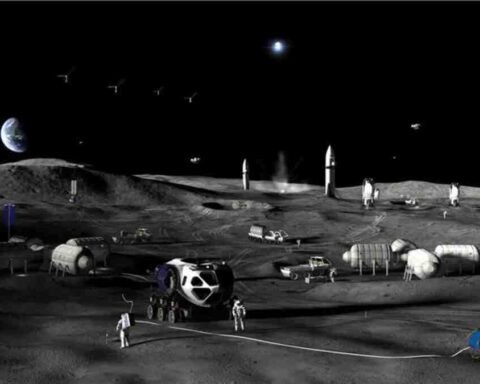
SpaceX is accelerating the development of its Starship rocket as it moves closer to supporting commercial cargo missions, marking a critical milestone in the company’s long-term vision for space logistics. Designed as a fully reusable launch system, Starship is intended to transform how large-scale cargo is transported to orbit, the Moon, and eventually Mars. Recent progress indicates that SpaceX is shifting from experimental testing toward operational readiness.
Starship’s appeal for commercial cargo lies in its unprecedented payload capacity. Once fully operational, the vehicle is expected to carry significantly more cargo than any existing rocket, while dramatically reducing launch costs through rapid reusability. For satellite operators, space agencies, and private companies, this opens new possibilities for deploying larger infrastructure, space stations, and heavy scientific equipment that were previously impractical or too expensive to launch.
In recent test campaigns, SpaceX has focused on refining key systems required for cargo missions, including propulsion reliability, heat shield durability, and controlled reentry. Successful high-altitude tests and improvements in booster recovery have demonstrated steady progress toward making Starship viable for repeat missions. Each test flight provides data that feeds directly into design upgrades, allowing SpaceX to iterate faster than traditional aerospace programs.
One of the most important developments is SpaceX’s work on orbital refueling. For long-duration cargo missions beyond low Earth orbit, Starship will rely on tanker variants that transfer propellant in space. This capability is essential for transporting large payloads to destinations like the Moon or deep-space orbits. Recent demonstrations have shown that SpaceX is making tangible progress toward mastering this complex operation, which is considered a cornerstone of future commercial and government missions.
Commercial interest in Starship is growing as its capabilities become clearer. Satellite companies are exploring how Starship could enable bulk satellite deployment or the launch of next-generation platforms that exceed current size limits. Space infrastructure startups see potential in using Starship to deliver modules for in-orbit manufacturing, data centers, or space habitats. For these players, Starship represents not just a new rocket, but a shift in what is economically possible in space.
Starship is also closely tied to government-backed programs that will indirectly accelerate its readiness for commercial cargo. Missions supporting lunar exploration require the same reliability, precision, and payload handling needed for private customers. As SpaceX meets these demanding requirements, the technology naturally matures for broader commercial use. This dual-use development model allows SpaceX to advance faster while spreading costs across multiple mission types.
From a logistics standpoint, Starship could reshape global space transportation. Its rapid turnaround design aims to enable frequent launches, reducing wait times that currently delay cargo deployment. Faster access to orbit means companies can respond more quickly to market demands, whether replacing satellites, launching time-sensitive payloads, or expanding orbital services.
There are still challenges ahead before Starship becomes a regular commercial cargo vehicle. Regulatory approvals, safety validation, and consistent mission success are critical hurdles. SpaceX must also demonstrate that full reusability can be achieved without excessive refurbishment costs. However, the company’s track record with Falcon 9 suggests it is capable of overcoming these obstacles through iterative engineering and operational experience.
If Starship achieves its intended performance, the impact on the space economy could be profound. Lower launch costs and higher payload capacity would lower barriers to entry, encouraging innovation across industries such as telecommunications, Earth observation, research, and space manufacturing. Entire business models could emerge around capabilities that Starship uniquely enables.
As SpaceX advances Starship toward commercial cargo missions, it is laying the groundwork for a new era of space logistics. The transition from testing to operational deployment signals that Starship is moving beyond ambition into execution. For the global space industry, this shift could redefine how cargo moves beyond Earth and accelerate the commercialization of space at an unprecedented scale.