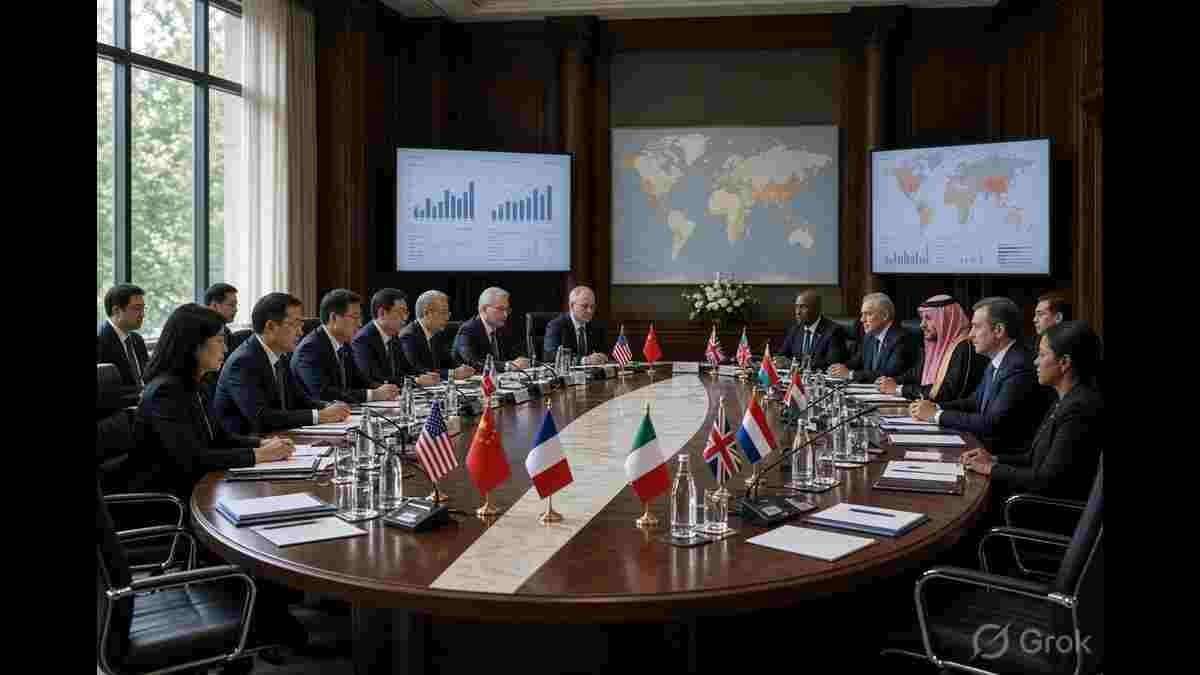
Finance ministers and central bank governors from the world’s biggest economies meet this week in Asheville, North Carolina, with a war that has already transformed energy markets and depressed growth in much of the world casting its shadow. The 20 under the auspices of the group, which encompasses all the world’s major industrial economies and several developing countries, has convened for an impromptu, two-day session. U.S.
Treasury Secretary Scott Bessent started the proceedings with a positive, growth-oriented approach while urging other participants to put Iran further to the pin of tighter controls. The fighting now in its sixth month has kept the strait of Gormuz de facto shut to conventional tankers, elevating energy prices, increasing the cost base for firms and family budgets, and detracting from economic momentum for nets importing a large share of their oil and gas from the Gulf. Bessent has committed to making Iran’s economic isolation the number one foreign policy objective.
He has issued warnings to countries that persist in purchasing Iranian oil or processing related transactions that they risk being subjected to secondary sanctions, That’s why shutting themselves out of the dollar-based financial system. The Treasury has already acted against a handful of banks purportedly connected to Iranian networks. Further measures had been foreshadowed in advance of the summit.
During the summit itself, the secretary tends to make this point in numerous bilateral conversations, emphasizing that the only way to sustain a presence in the Western financial system is by adhering to the demand that they isolate Iran. A broader agenda of the G20’s familiar themes. From the White House you had various officials talking about how to support private-sector innovation, how to deepen the supply chains of critical goods, how to rectify the world’s trade imbalances and how to help allay the mounting sovereign debt burden.
Of course the Federal Reserve Chair Kevin Warsh and Bessent repeated the expectation that the global economy might now enter a new era of stronger investment-led growth. The focus even so remains on the energy shock. Elevated crude prices have filtered into inflation fears and created additional policy challenges to central banks still wrestling with the consequences of their previous step. Diplomacy at this meeting is tangled in other strains. Difficult trade tensions with the US’s closest allies, including Canada, are ongoing, and China, Iran’s biggest customer for its oil, will complicate an agreement between any state or group of states on sanctions. Even some of the US’s closest allies wonder whether anything close to unanimity can be reached around the table, which includes Russia. But the US is taking advantage of being the host to keep the campaign visible and measure its progress with other large economies.
For most ordinary households and enterprises the impacts are already tangible. Prices for fuel are still high in many markets. Manufacturers are paying more for their inputs. Transport routes have been longer and far more costly. The overall drag has been felt most acutely in energy importing countries, but the downstream effects have spread across essentially every G20 state. Bessent has claimed that a long-lasting financial squeeze can compel a settlement without the necessity of another round of military escalation, with the cost of Iran’s economy mounting to a desperate level within weeks if the blockade and sanctions are sustained.