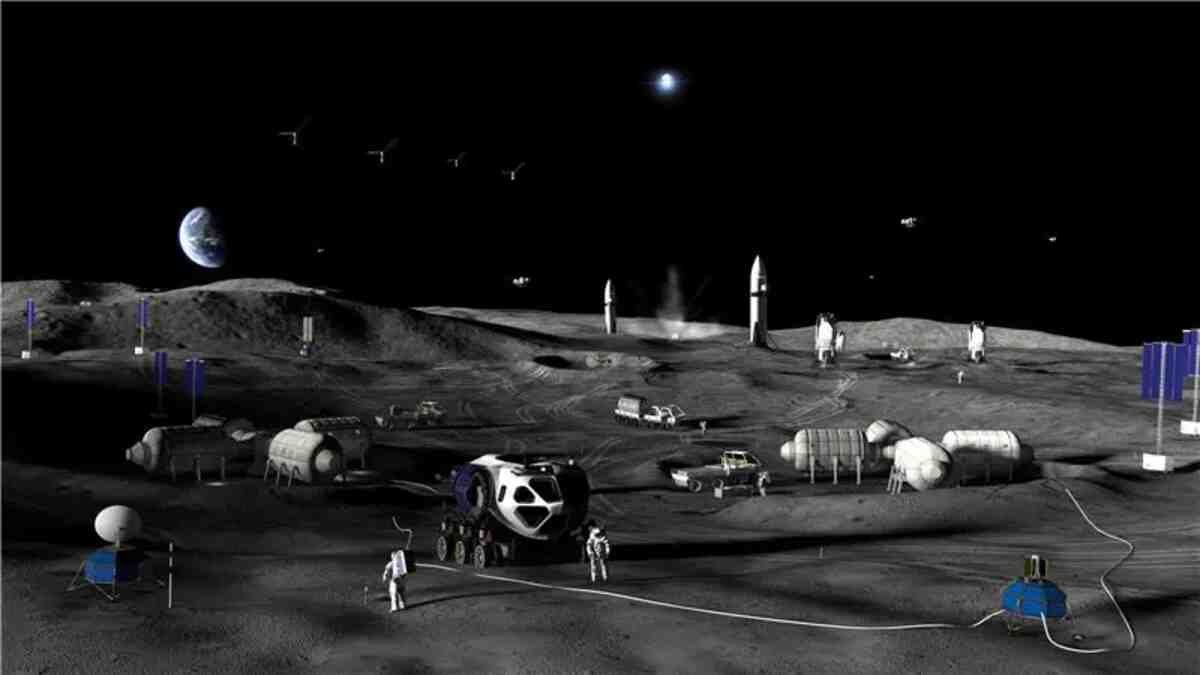
NASA has taken a bold step toward redefining the future of space exploration by accelerating its Artemis program with a massive $20 billion investment to build a permanent base on the Moon. This decision marks a major shift in strategy, signaling that the agency is no longer focused on short-term missions but is now aiming to establish a long-term human presence beyond Earth.
The new plan centers on constructing a fully functional lunar base near the Moon’s south pole, an area believed to contain water ice and valuable resources. Scientists consider this location critical because it can support life and fuel production, making it a strategic hub for future space missions.
Unlike earlier missions such as Apollo, which focused on brief visits, the Artemis program is designed for sustainability. The goal is not just to land astronauts but to keep them there for extended periods. This includes building habitats, deploying advanced rovers, and installing power systems that can support continuous operations on the lunar surface.
One of the most significant changes in this new approach is NASA’s decision to cancel its planned Lunar Gateway space station and redirect resources toward building infrastructure directly on the Moon. This shift simplifies mission planning and accelerates the timeline for establishing a permanent base.
The development of the moon base will take place in multiple phases. Initially, robotic missions will prepare the surface and test technologies. This will be followed by crewed missions that bring essential equipment and begin assembling semi-permanent structures. Eventually, the project will evolve into a fully operational base capable of supporting astronauts for months at a time.
The Artemis program is also closely tied to broader ambitions in space exploration. NASA sees the Moon as a stepping stone for future missions to Mars. By testing life-support systems, energy solutions, and habitation technologies on the Moon, scientists can better prepare for the challenges of deep space travel.
Another major highlight of the plan is the integration of advanced technologies, including nuclear power systems that can provide reliable energy in the harsh lunar environment. These systems are expected to play a crucial role in maintaining operations during long lunar nights, when solar power is not available.
The push for a lunar base is also driven by growing global competition. With countries like China planning their own moon missions in the coming years, NASA’s accelerated timeline reflects a renewed urgency to maintain leadership in space exploration.
At the same time, the Artemis program is creating significant opportunities for private companies. Firms such as SpaceX and Blue Origin are involved in developing lunar landers and other technologies, making this a collaborative effort between government and industry. This partnership model is expected to drive innovation while reducing costs over time.
Despite its ambitious scope, the project faces several challenges. Building infrastructure on the Moon requires overcoming extreme temperatures, radiation exposure, and logistical constraints. Transporting materials, ensuring astronaut safety, and maintaining long-term operations are complex problems that NASA and its partners must solve.
Even with these challenges, the momentum behind the Artemis program is undeniable. With missions planned throughout the decade and increasing investment in space technology, the vision of humans living and working on the Moon is closer than ever before.
The accelerated moon base plan represents more than just a technological milestone. It signals a new era in human exploration, where space is no longer a distant frontier but a place where long-term habitation is becoming a reality. As NASA continues to push forward, the Artemis program is set to redefine humanity’s relationship with space and open the door to the next chapter of exploration.